How to Write a Gym Business Plan (Template Included)
The financial model, staffing plan, and launch checklist a new gym owner actually needs, not generic business-plan boilerplate.
 The Atlas Team October 8, 2026 6 min read
On this page
A gym business plan needs six sections: an executive summary, a market analysis, your membership and pricing model, financial projections with a break-even figure, a staffing plan, and a marketing and launch plan. Everything else is optional. What makes a gym plan different from a generic template is that three of those sections (pricing, break-even and the launch plan) depend on numbers specific to fitness, not business in general.
1. Executive summary
Write this last, but put it first. It is one page: what kind of facility you are opening, where, who it serves, how much money you need, and what the plan proves. If you cannot summarise the plan in a page, the plan is not finished.
2. Market analysis
Two questions matter more than the rest: how many people within a realistic drive time could join, and who is already serving them. Count the competing gyms, note their pricing and their hours, and look for the gap: 24-hour access, women-only hours, small-group training, or a location nobody wants to drive past. A saturated local market is not a reason to stop. It is the evidence that tells you which wedge you are entering with.
This is also where you decide your capacity, because capacity sets your revenue ceiling. A 3,000 sq ft studio and a 20,000 sq ft gym have entirely different break-even maths, and the plan should show you know which one you are building.
3. Membership and pricing model
Your pricing model is a strategic decision, not a spreadsheet row. The three common shapes are a single monthly price, tiered plans, and a free-or-cheap entry tier that converts upward. Each implies a different kind of gym: a single price competes on simplicity, tiers compete on serving different member types, and an entry tier competes on removing the risk of trying you.
Whatever you choose, model a realistic member mix rather than one average price. If 40% of members are on a discounted annual plan and 10% buy day passes, a break-even built on the headline monthly rate is wrong by a wide margin. Write down the assumed mix and the assumed average revenue per member, then check the plan still works if churn is twice what you hope.
As one illustrative shape, Atlas is priced as tiered monthly subscriptions with a free tier for up to 50 members, so a small gym can start without a software bill. Use it as an example of how tiers work, not as a template. The right pricing for your gym is the one your local market will actually pay. The Atlas pricing page lays the structure out in full.
4. Financial projections and break-even
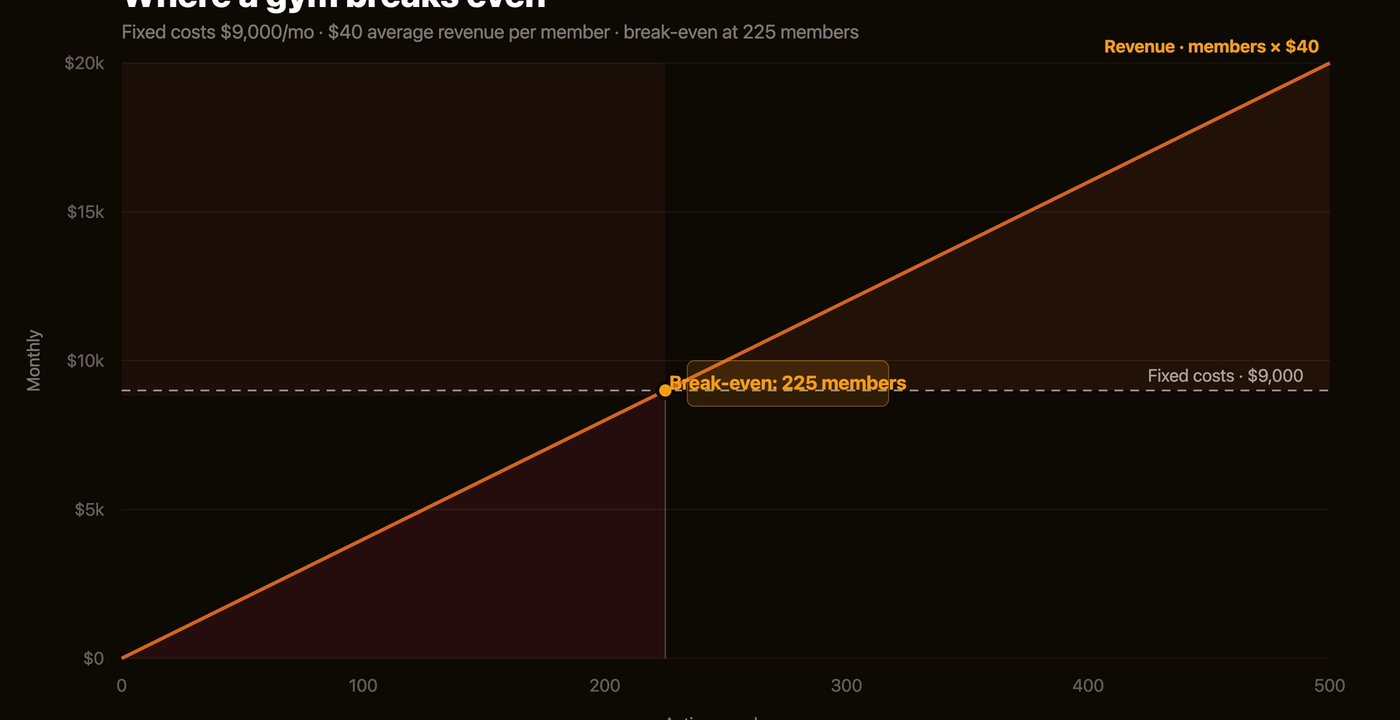
This is the section lenders and landlords read first. Build it on three drivers: fixed monthly costs, average revenue per member, and churn. Your break-even member count is fixed monthly costs divided by average revenue per member. Everything above that number is your margin.
| Line | Figure | How it is worked out |
|---|---|---|
| Fixed monthly costs | $9,000 | Rent, utilities, staff, insurance and software |
| Average revenue per member | $40 a month | Blended across all plan types |
| Break-even | 225 members | $9,000 divided by $40 |
| Capacity of 500 members | 45% full at break-even | 225 divided by 500. Room to absorb a slow ramp |
| Capacity of 250 members | 90% full at break-even | 225 divided by 250. One bad month of churn puts you below the line |
Illustrative numbers for the method only. Replace every figure with quotes from your own landlord, suppliers and local market.
The plan should show both the break-even count and how many months of runway you have before you reach it. Then put a churn line in the projections deliberately. A gym that loses 3% of members a month and adds the same number is standing still, and most first-time plans quietly omit this. Model gross adds and gross losses separately, not a single net number.
Run the numbers on a real member base
Atlas is free for your first 50 members, so you can test your plans, pricing and check-in before you commit to a lease.
5. Staffing plan
Gyms are staffed in two layers: a small core of full-time people such as a manager, a head trainer and membership sales, and a larger flexible layer of part-time trainers and front-desk staff. Plan the core as fixed cost and the flexible layer as variable, scaled to opening hours.
A 24-hour gym trades staffing cost for access-control hardware. A class-based studio trades hardware for instructor hours. Whichever you are, the plan should state opening hours and the minimum staffing to cover them, because that number drives your largest variable cost.
6. Marketing and launch plan
The launch plan answers one question: how do the first 100 members find you? Pre-sale pricing, a founding-member rate, a launch event and a local referral offer are the standard tools. Budget it as a real line item with a cost per acquired member, and set a target. A launch plan with no cost-per-member estimate is a wish.
Common mistakes first-time gym owners make
- Underestimating churn. The plan that survives is the one that still works when 4% of members leave every month, not 1%.
- No budget line for access control. Biometric or RFID door access is either part of your software or a separate vendor. Either way it costs money and appears in no generic template.
- No plan for failed payments. Card declines, expired cards and involuntary churn are the quiet killer of gym revenue. Decide up front how you retry, notify and, if needed, deactivate access.
- Pricing by guesswork. Copying the gym down the road ignores your cost base and your differentiator.
- Treating the plan as a one-off. It is a live document. The assumptions that were wrong in month one should be corrected by month three.
Frequently asked questions
How long should a gym business plan be?
Long enough to cover each of the six sections with real numbers, with a one-page executive summary on top. A lender wants evidence in the financials, not length.
How do I calculate break-even for a gym?
Divide your fixed monthly costs by your average revenue per member. The result is the number of paying members you need each month to cover costs.
How much churn should I plan for?
Test the plan at 4% of members leaving each month as well as your hoped-for figure. If it only works at 1%, it is too fragile.
Should the plan include software costs?
Yes. Include a budget line for management software and, if you want door access, for access control, since it sits outside most generic templates.
A gym business plan is not a formality for the bank. Written properly, it is the first time your assumptions are forced onto one page where you can see them. Start with the six sections, stay honest about churn and access control, and revisit it once you have real members. If you are still choosing software, the gym software page and the pricing page are the two to read next. The first operational document you will write after opening is a fair cancellation policy, and we show how to write one.
Ready to open with your front desk sorted?
Start free, add your plans and see how it runs before your doors open.